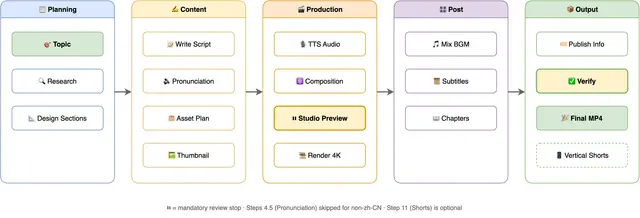
Video Podcast Maker Nano
Smallest personal narrated-explainer-video pipeline (spoken narration over visuals, not...
Install
npx skills add Agents365-ai/video-podcast-maker --skill video-podcast-maker-nano -g -a claude-code -y- Repository
- Agents365-ai/video-podcast-maker1.7k
- Category
- AI and agents
- Updated
- 1mo ago
- License
- MIT
- Context cost
- Mediumabout 3,000 tokens
- Runs scripts
- No, instructions only
What it does
Smallest personal narrated-explainer-video pipeline (spoken narration over visuals, not an audio podcast), fully tool-agnostic and autonomous by default, topic → research ∥ asset collection → script → TTS → video → 4K render ∥ publish info + cover. The skill defines the pipeline logic and self-verified checkpoints; any TTS backend and any video tool (Remotion, HyperFrames, CapCut, ...) work, and how much human oversight to apply is set by the working project's AGENTS.md/CLAUDE.md, not here. Use when the user wants a quick personal narrated video with minimal steps, whether or not they name the tool stack. Do NOT trigger for audio-only podcasts, written episodic content, or heavy multi-format production.
Video Podcast Maker Nano
A 7-step pipeline for personal use: research ∥ materials → script → TTS → audio checkpoint → video → preview checkpoint → 4K render ∥ publish kit. No bundled scripts, no hardcoded backends, no templates. The skill owns the logic and runs autonomously by default; the TTS backend and video tool are chosen per video (see Tool selection).
What makes this work regardless of tool choice, the three invariants:
- Checkpoints are never skipped, but who checks is policy. Three checkpoints exist: script (after Step 2), audio (after Step 3), preview (before render). Default checker is the agent itself (self-verification, defined per checkpoint); a project's AGENTS.md/CLAUDE.md may upgrade any checkpoint to a human gate, see Oversight policy.
- Audio is the master clock. The final video's duration must match the narration audio within ±0.5s (
ffprobeboth). Visuals are cut to the audio, never the reverse. - A script change invalidates everything downstream. Edit the script → re-run the script checkpoint, then TTS → audio checkpoint → visuals → preview checkpoint → render. Never hand-patch timings.
Oversight policy
Default mode is autonomous: the pipeline runs end to end, with the agent performing every checkpoint's self-verification. A working project's AGENTS.md/CLAUDE.md can override per checkpoint with one line each:
Checkpoint 1 (script): human, halt after Step 2 until the user approves the script. Worth it: a late script change costs a full re-run.Checkpoint 2 (audio): human, the user listens to the full audio before visuals. Worth it when TTS misreadings are costly to catch later.Checkpoint 3 (preview): human, the user reviews the draft before render. Worth it for style-sensitive channels.




