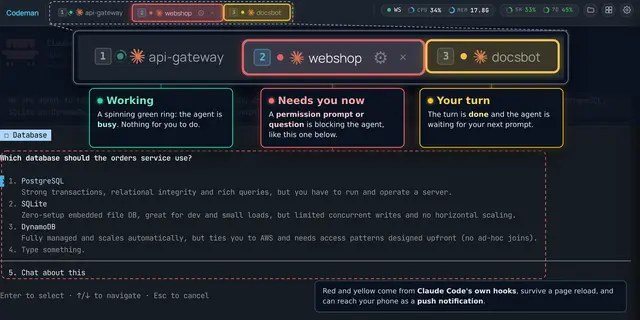
Codeman
Drive Codeman, the session manager this agent is running inside, over its HTTP API...
Install
npx skills add Ark0N/Codeman --skill codeman -g -a claude-code -y- Repository
- Ark0N/Codeman828
- Category
- AI and agents
- Updated
- 4d ago
- License
- MIT
- Context cost
- Mediumabout 3,000 tokens
- Runs scripts
- Yes, review before use
What it does
Drive Codeman, the session manager this agent is running inside, over its HTTP API, from any agent CLI (Claude Code, Codex, Gemini CLI, OpenCode, Antigravity, Grok Build, DeepSeek Harness, OMP): list sessions, start worker sessions in any installed CLI, send them prompts, block until they finish (wait / wait-output / send-and-wait), read their output, and clean up; where available, message claude workers directly (Claude Code cross-session messaging). Use when asked to orchestrate or parallelize work across Codeman sessions, get a second opinion from another CLI or model, watch another session, start and manage workers, or retrieve saved local Codex history by file/native ID or root and descendants with topic/date filters. Live API operations require a Codeman-managed session (CODEMAN_MUX=1). Offline history reads do not require a server or managed session.
Driving Codeman from inside a session
For saved Codex conversation history, use codeman history read and
reference/history.md. This is a read-only local command:
route to it before §0, including outside a managed session. It needs no API
URL, credentials or running server. All live API operations below retain §0.
You are an agent running inside a Codeman-managed terminal session. Codeman is the server that spawned you; its HTTP API can start, prompt, watch, and delete other sessions.
Read as far as your job needs and no further. §0 is the bootstrap, run once. §1 is the whole fast path: spawn N workers, task them, collect answers. If §1 covers your job, run it and stop there. The sections after it are for jobs it does not cover, and reading them to be thorough is the main reason a ten-second run takes minutes. §2 is the verb table when your job is a different one. §3 and §4 are the rules; §6 is setup and credentials, which you only need when something 401s.
Everything else loads on demand, and is meant to be opened at one section, not read through: the verbs in detail (the old §5) in reference/verbs.md, worked multi-worker flows in reference/recipes.md, endpoint tables and a symptom gallery in reference/endpoints.md, and direct messaging to claude workers in reference/messaging.md. Experimental bounded inspection and guarded stage/submit load only when needed from reference/inspection-and-staging.md.




