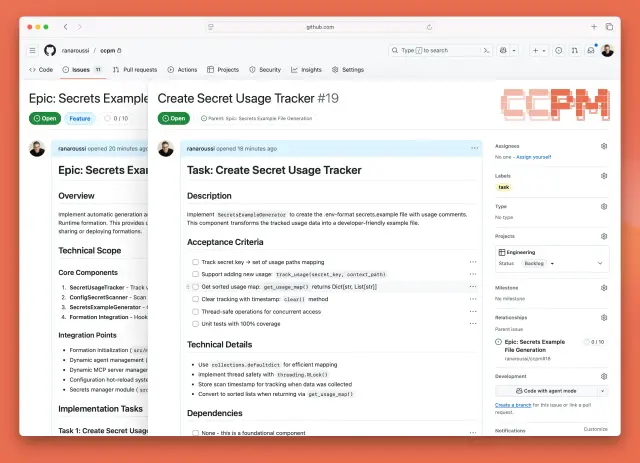
CCPM Project Management
Turns a PRD into an epic, GitHub issues and parallel agent work.
Install
npx skills add automazeio/ccpm --skill ccpm -g -a claude-code -y- Repository
- automazeio/ccpm8.4k
- Category
- Engineering
- Updated
- 16d ago
- License
- MIT
- Context cost
- Lightabout 885 tokens
- Runs scripts
- Yes, review before use
What it does
CCPM - spec-driven project management: PRD → Epic → GitHub Issues → parallel agents → shipped code. Use this skill for anything in the software delivery lifecycle: writing a PRD ('write a PRD for X', 'let's plan X', 'scope this out'), parsing a PRD into an epic, decomposing an epic into tasks, syncing to GitHub ('sync the X epic', 'push tasks to github'), starting work on an issue ('start working on issue N', 'let's work on issue N'), analyzing parallel work streams, running standups ('standup', 'run the standup'), checking status ('what's next', 'what's blocked', 'what are we working on'), closing issues, or merging an epic. Use ccpm any time the user is talking about shipping a feature, managing work, or tracking progress, even if they don't say 'ccpm' or 'PRD'. Do NOT use for: debugging code, writing tests, reviewing PRs, or raw GitHub issue/PR operations with no delivery context.
CCPM - Claude Code Project Manager
A spec-driven development workflow: PRD → Epic → GitHub Issues → Parallel Agents → Shipped Code.
Core Philosophy
Requirements live in files, not heads. Every feature starts as a PRD, becomes a technical epic, decomposes into GitHub issues, and gets executed by parallel agents with full traceability.
File Conventions
Before doing anything, read references/conventions.md for path standards, frontmatter schemas, and GitHub operation rules. These apply to all phases.
The Five Phases
1. Plan, Capture requirements
When: User wants to define a new feature, product requirement, or scope of work.
Read: references/plan.md
Covers: Writing PRDs through guided brainstorming, converting PRDs to technical epics.
2. Structure, Break it down
When: An epic exists and needs to be decomposed into concrete tasks.
Read: references/structure.md
Covers: Epic decomposition into numbered task files with dependencies and parallelization.
3. Sync, Push to GitHub
When: Local epic/tasks need to become GitHub issues, progress needs to be posted as comments, or a bug is found and needs a linked issue created.
Read: references/sync.md
Covers: Epic sync (epic + tasks → GitHub issues), issue sync (progress comments), closing issues/epics, bug reporting against completed issues.
4. Execute, Start building
When: User wants to start working on one or more GitHub issues with parallel agents.
Read: references/execute.md
Covers: Issue analysis (parallel work stream identification), launching parallel agents, coordinating worktrees.
5. Track, Know where things stand
When: User asks for status, standup report, what's blocked, what's next, or needs to validate state.
Read: references/track.md
Covers: Status, standup, search, in-progress, next priority, blocked items, validation.



