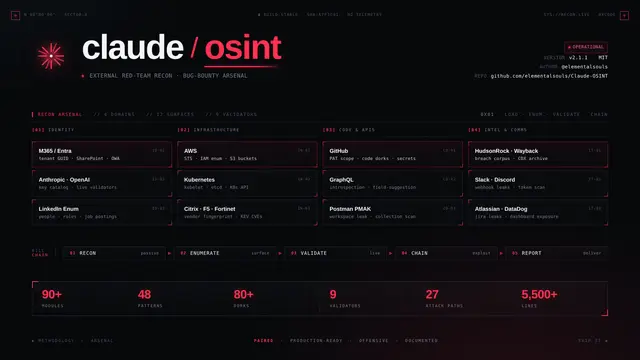
Cloud Saas Exposure
Organization-grade cloud and supply-chain attack-surface discovery: S3/GCS/Azure Blob...
Install
npx skills add elementalsouls/Claude-OSINT --skill cloud-saas-exposure -g -a claude-code -y- Repository
- elementalsouls/Claude-OSINT2.9k
- Category
- Testing
- Updated
- 15d ago
- License
- MIT
- Context cost
- Mediumabout 3,000 tokens
- Runs scripts
- No, instructions only
What it does
Organization-grade cloud and supply-chain attack-surface discovery: S3/GCS/Azure Blob bucket discovery via observed-name mining (CNAME/cert-SAN/Wayback) and bounded two-class permutation (6 prefixes x 15 suffixes on trusted tokens, bounded target-bound expansion on subdomain stems), existence (HEAD/GET) vs public-listing confirmation, object-key triage into 9 value tiers (database dumps, credentials, IaC state, kubeconfig, VCS dirs, config, archives, PII, logs), dangling-CNAME bucket-takeover detection, and the ownership-gated severity model that stops an unattributable public bucket from becoming a false CRITICAL; the fully offline AWS-account-ID recovery from a leaked AKIA/ASIA/AROA access key (base32 decode, runnable stdlib Python, canonical test vector, AWS-documentation-example-ID screening); dependency-confusion confirmation for npm/PyPI (internal-signal classifier -- private-registry binding vs org-namespace match -- paired with a read-only public-registry 404 check and the npm scope-claimability nuance the public search API misses); and passive cloud-native/container/Kubernetes/CI control-plane fingerprinting (Lambda URLs, API Gateway, Cloud Run, App Service, kubelet/etcd/K8s API/dashboard, Jenkins/GitLab/Argo CD) as an org-attribution and exposure surface. Passive/discovery only -- no exploitation, no credential submission, no active control-plane confirmation (a stage-6 validate_cloud active tier is described but out of scope). Use when enumerating a target's cloud
Cloud & SaaS Exposure, Buckets, Offline AWS Account-ID Recovery, Dependency Confusion, and Cloud-Native/K8s Fingerprinting
Companion skills:
osint-methodology(the pipeline this plugs into, Stage 2 asset expansion, Stage 4 exposure analysis, Stage 5 supply-chain confirmation).offensive-osint§16.8 (bucket-permutation raw wordlist), §16.17 (cloud-native URL pattern table), §16.18, > §16.19 (container/K8s/CI paths + active curl recipes), §44 (package-registry search). This skill does not repeat those lists, it builds the reasoning layer on top: the ownership-gated bucket severity model, the offline AKIA→account-ID decode, the dependency-confusion two-part confirmation contract, and cloud-native/K8s as an org-attribution surface, not just another probe list.
0. When to Use / When NOT
Use this skill when: you're mapping an authorized target's cloud and supply-chain footprint, enumerating storage buckets and judging whether a hit is actually the target's risk (not a stranger's public bucket that happens to match a permutation); recovering the AWS account ID behind a leaked access key you already hold (dead or live); confirming whether an internal-looking npm/PyPI dependency is a registerable supply-chain vector; or fingerprinting cloud-native (Lambda/Cloud Run/App Service/…) and container/K8s/CI control-plane surface for org attribution and exposure triage.
Do NOT use this skill when: you just need the raw bucket-permutation wordlist,
cloud-native URL pattern table, or container/K8s/CI path list with no reasoning layer, go
straight to offensive-osint §16.8/§16.17, 16.19/§44. Do NOT use it for anything past
discovery/confirmation: registering an unclaimed package, submitting AWS credentials,
authenticating to a Kubernetes API, or confirming a fingerprinted control plane actually
answers unauthenticated (that's a stage-6 --validate --validate-cloud active tier, described, never performed, §5/§9.4).





