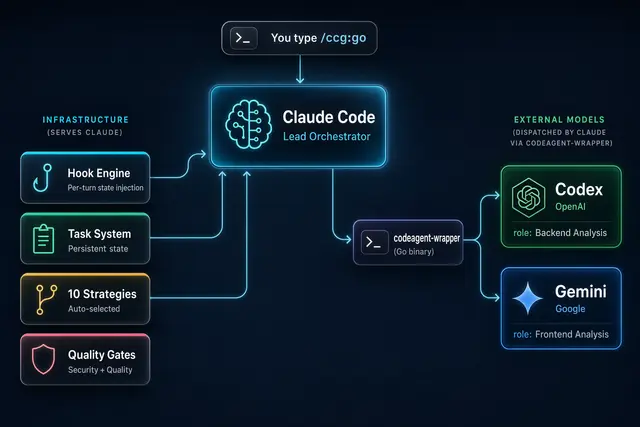
End-to-End Change Workflow
Runs a non-trivial change through analysis, design, build, review and test gates.
Install
npx skills add fengshao1227/ccg-workflow --skill ccg-workflow -g -a claude-code -y- Repository
- fengshao1227/ccg-workflow6k
- Category
- Engineering
- Updated
- 14d ago
- License
- MIT
- Context cost
- Mediumabout 2,163 tokens
- Runs scripts
- No, instructions only
What it does
How to run a non-trivial change end to end with the CCG role tools (ccg_analyze / ccg_design / ccg_build / ccg_debug / ccg_optimize / ccg_review / ccg_test) and the verify-* quality gates. Use when a task is a whole feature, a refactor, a bug whose cause is not yet known, or any change large enough that one straight-through attempt would be a guess.
CCG workflow
Seven role tools are available, each running a child agent on its own model with its own expert persona. This is how to chain them so the work converges instead of sprawling.
Skip all of this for small, obvious work. A one-line fix, a rename, a question you can answer by reading two files, do it yourself. Delegation buys depth, and it costs a round trip and a fresh context. Spend it only where depth is the thing you lack.
Picking a gear
Four modes. The user should not have to name one: read what they asked for, pick, say which you picked in a line, and, for anything past Direct, say what it costs and wait for a yes. They are paying per model call.
| Mode | For | Runs |
|---|---|---|
| Direct | a one-line fix, a rename, a question you can answer by reading | you, alone |
| Standard | an ordinary feature, a bug with a known cause, a contained refactor | design → build → review |
| Deep | a design with real alternatives, an unclear bug, a migration, anything expensive to get wrong | analyze → design → build → test → review |
| Team | work that splits across files and will keep developing | ccg_team, several specialists at once, each owning its own files |
A role holding several models answers with all of them at once, so Deep costs more than its phase count suggests, quote the real number of model calls, not the number of phases. If the user names a mode, run that one. If a phase changes what you believe, say so and re-pick rather than finishing a plan you no longer believe in.
Deep and Team are not a ranking. Deep buys certainty about one thing by asking several models about it. Team buys throughput on several things by running colleagues at once. A hard question is Deep even if it is small; a wide job is Team even if every part is easy. Something both hard and wide is Deep first, settle the design and the contracts, then Team to build it.



