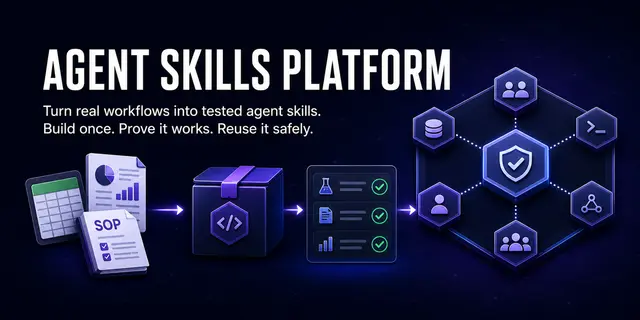
Agent Skills Platform
Create cross-platform agent skills from workflow descriptions.
Install
npx skills add FrancyJGLisboa/agent-skills-platform --skill agent-skills-platform -g -a claude-code -y- Repository
- FrancyJGLisboa/agent-skills-platform2.4k
- Category
- Security
- Updated
- 2mo ago
- License
- MIT
- Context cost
- Mediumabout 3,000 tokens
- Runs scripts
- No, instructions only
What it does
Create cross-platform agent skills from workflow descriptions. Activates when users ask to create an agent, automate a repetitive workflow, create a custom skill, or need advanced agent creation. Triggers on phrases like create agent for, automate workflow, create skill for, every day I have to, daily I need to, turn process into agent, need to automate, create a cross-platform skill, validate this skill, export this skill, migrate this skill, audit this skill, is this skill safe, vet a skill before installing, what does this skill access. Supports single skills, multi-agent suites, transcript processing, template-based creation, interactive configuration, cross-platform export, spec validation, and security auditing of third-party skills before install.
/agent-skills-platform, Turn Existing Work Into a Reusable Skill
The user provides whatever already represents their work, a description, document, link, script, screenshot, transcript, or partial example. Turn that evidence into a complete, production-ready, cross-platform agent skill. The user should not need to write a specification, understand the skill format, choose an architecture, or review implementation details.
Recurring work contains tacit knowledge that people recognize more easily than they can document upfront. Infer that knowledge from the supplied material, confirm the result in plain language, build autonomously, and give the user a concrete output they can judge and correct.
The User Journey
Use this guided-light path by default. Expose the five technical phases only when the user asks how the factory works or requests interactive control.
- Understand, read the evidence and summarize the question, trigger, supported decision, required evidence, and measurable success condition alongside the workflow, input, and output. Ask for one confirmation or correction.
- Build, create the skill autonomously. Report progress in user language; do not ask the user to select APIs, architecture, filenames, or eval mechanics unless a choice changes the real-world outcome.
- Check, run validation, pipeline, security, and eval gates. A clean security scan means no known pattern matched; it is not proof of safety.
- Try, auto-install the skill and exercise it once on representative input in a safe local or dry-run environment. Show the output and ask whether it matches the user's work.
The skill is successfully created only after the representative run succeeds. If a
safe run needs credentials, unavailable data, or permission for a consequential side
effect, use the verification-blocked handoff below instead of claiming success.