Time Of Day
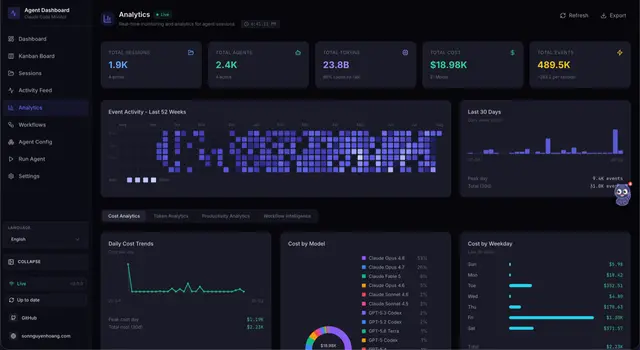
Discover when you are most active and most productive with Claude Code by bucketing...
Install
npx skills add hoangsonww/Claude-Code-Agent-Monitor --skill time-of-day -g -a claude-code -y- Repository
- hoangsonww/Claude-Code-Agent-Monitor1.1k
- Category
- AI and agents
- Updated
- 5d ago
- License
- MIT
- Context cost
- Lightabout 639 tokens
- Runs scripts
- No, instructions only
What it does
Discover when you are most active and most productive with Claude Code by bucketing sessions and events into hour-of-day and day-of-week bins from their timestamps, then flagging peak versus low-output windows. Uses the session list, per-session events, and analytics daily trends. Use when planning a schedule or deciding when to do deep work versus lighter tasks.
Time of Day
Profile activity and productivity across the hours of the day and days of the week.
Input
The user provides: $ARGUMENTS
This may be:
- empty or "all" (default: all available sessions)
- a window like "last 30 days" or "last 90 days" to limit the analysis
- a project path to scope the analysis to one
cwd
Data Sources
| Endpoint | Returns |
|---|---|
GET /api/sessions?limit=500 | Sessions with started_at, ended_at, status, cwd, cost, and metadata (turn_count, total_turn_duration_ms), primary source for hour/weekday bucketing |
GET /api/events?session_id=X | Events with timestamp and event_type (PreToolUse, PostToolUse, Stop, Compaction, APIError, etc.), finer-grained activity within sessions and error timing |
GET /api/analytics | daily_sessions / daily_events (365d) and sessions_by_status for trend context and completion baselines |
Report Sections
1. Activity by Hour of Day
Bucket sessions (by started_at) and events (by timestamp) into 24 hourly bins.
Show a text bar chart of session and event counts per hour. Identify the busiest
hours by raw volume.
2. Productivity by Hour of Day
For each hour bin, compute completion rate (completed / total sessions started in
that hour) and average sustained turn time
(total_turn_duration_ms / turn_count, ms → minutes). Distinguish "active" hours
(high volume) from "productive" hours (high completion + sustained turns).
3. Day-of-Week Pattern
Bucket the same metrics into 7 weekday bins. Table: weekday, sessions, completion rate, avg cost, dominant model.
4. Peak vs. Low-Output Windows
- Peak windows: hours/days with high completion rate and long sustained turns.
- Low-output windows: hours/days with high abandonment/error/Compaction rates
or fragmented short turns. Pull error timing from
/api/eventsevent types (APIError, Compaction) to corroborate.