Brooks Audit
Architecture audit that maps module dependencies, checks layering integrity, and flags...
Install
npx skills add hyhmrright/brooks-lint --skill brooks-audit -g -a claude-code -y- Repository
- hyhmrright/brooks-lint1.6k
- Category
- Git and review
- Updated
- 9d ago
- License
- MIT
- Context cost
- Lightabout 331 tokens
- Runs scripts
- No, instructions only
What it does
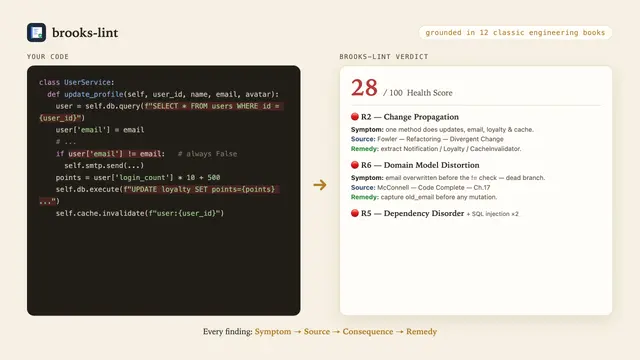
Architecture audit that maps module dependencies, checks layering integrity, and flags structural decay across a codebase, drawing on twelve classic engineering books. Triggers when: user asks to audit architecture, review folder/module structure, check for circular imports, understand how the codebase is organized, or asks "does this follow clean architecture?" or "why does everything depend on everything?". Also triggers for onboarding requests: "explain this codebase to a new developer" or "give me a codebase tour" (use onboarding mode). Do NOT trigger for: PR-level code review (use brooks-review) or line-level refactoring questions, this skill analyzes structural/module-level concerns, not individual functions.
Brooks-Lint, Architecture Audit
Setup
Read in order:
../_shared/common.md, Iron Law, Project Config, Report Template, Health Score../_shared/source-coverage.md, book coverage, exceptions, tradeoffs../_shared/decay-risks.md, symptom definitions and source attributionsarchitecture-guide.md(this directory), the audit framework
Process
Onboarding mode: If the user asks for an onboarding report, codebase tour, or
"explain this codebase to a new developer", read onboarding-guide.md from this
directory and follow it instead of architecture-guide.md. This mode explains rather
than diagnoses, no Health Score, no Iron Law findings.
Scope: if the user did not specify files or a directory, apply Auto Scope Detection
(../_shared/common.md) first.
- Gather codebase context and draw the module dependency graph as Mermaid (Steps 0, 1 of the guide)
- Scan for each decay risk in the order specified (Steps 2, 4 of the guide)
- Assign node colors in the Mermaid diagram based on findings (red/yellow/green), after Step 4
- Run the Testability Seam Assessment (Step 5 of the guide)
- Run the Conway's Law check (Step 6 of the guide)
- Output using the Report Template from common.md, Mermaid graph FIRST, then Findings
Mode line in report: Architecture Audit