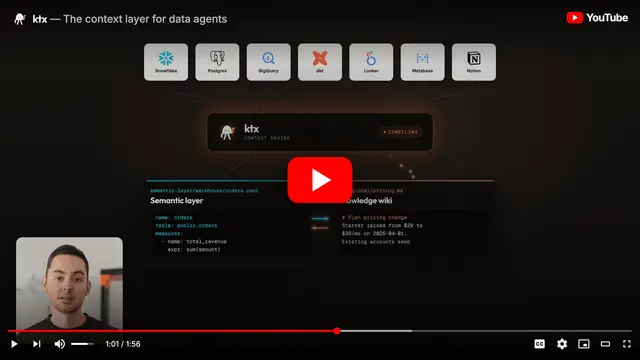
Sl
Ktx's semantic layer - a structured catalog of sources (tables/views), measures, joins...
Install
npx skills add Kaelio/ktx --skill sl -g -a claude-code -y- Repository
- Kaelio/ktx1.6k
- Category
- AI and agents
- Updated
- 13d ago
- License
- Apache-2.0
- Context cost
- Mediumabout 2,576 tokens
- Runs scripts
- No, instructions only
What it does
ktx's semantic layer - a structured catalog of sources (tables/views), measures, joins, and segments expressed as YAML. Covers the schema and how to query it via `sl_query`. Use when the task involves querying pre-defined metrics (ARR, churn, retention, LTV, MAU) or reading SL source YAML to understand the catalog. Capture is handled by the `sl_capture` skill (memory-agent only).
Semantic Layer
ktx's semantic layer (SL) is a structured catalog. Each source represents a table, a SQL view, or an overlay that enriches a manifest-backed table with measures, computed columns, joins, and named segments. The catalog is the single source of truth for reusable business metrics.
This skill covers two parts:
- Part 1 - Schema reference (what an SL source looks like).
- Part 2 - Querying via
sl_query.
Capture (when and how to add new patterns to the SL) is a separate concern handled by the memory-agent - see the sl_capture skill if you are running in capture mode. The research agent reads and queries the SL via the tools described here; it does not write to it.
For capture-time identifier verification, load sl_capture. Synthesis writer
skills must verify warehouse identifiers with discover_data,
entity_details, and sql_execution before emitting table or column names.
Part 1 - Schema reference
An SL source is a YAML file under semantic-layer/<connectionId>/. The file's name: field is the source's identity, it mirrors the warehouse identifier verbatim (e.g. Snowflake's uppercase SIGNED_UP); the filename is only a derived label. Always address sources by name through the sl_* tools, never by file path. There are three flavors:
Overlay sources
Enrich a manifest-backed table with measures, computed columns, joins, and segments. No table or sql field. The base table's columns and grain are inherited from the manifest.




