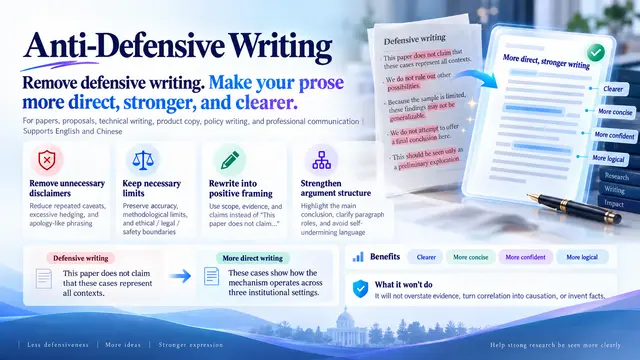
Anti Defensive Writing
Reduce defensive writing in drafts and revisions by removing unnecessary caveats...
Install
npx skills add Kiterlin/anti-defensive-writing --skill anti-defensive-writing -g -a claude-code -y- Repository
- Kiterlin/anti-defensive-writing1.6k
- Category
- Writing
- Updated
- 18d ago
- License
- MIT
- Context cost
- Mediumabout 3,000 tokens
- Runs scripts
- No, instructions only
What it does
Reduce defensive writing in drafts and revisions by removing unnecessary caveats, disclaimers, hedges, apology-like framing, negative self-limiting statements, and over-explanations while preserving necessary scope, accuracy, safety, legal, ethical, and methodological limits. Use when drafting or revising academic writing, papers, essays, abstracts, introductions, contribution statements, discussions, conclusions, technical explanations, grant writing, product writing, policy writing, professional reports, or any text the user wants to be clearer, stronger, more direct, more concise, more confident, less verbose, less caveated, less apologetic, or less defensive.
Anti-Defensive Writing
Core Rule
Advance the claim directly.
Say what is true, what the text argues, what the evidence shows, or what the method does. Do not default to explaining what the text does not claim, does not prove, does not imply, does not cover, or does not attempt.
Use a calm, competent authorial posture. Write as an author explaining an argument to the reader, not as an author negotiating with an imagined critic.
Preserve Necessary Precision
Keep limitations when they are necessary for accuracy, ethics, law, safety, or methodological transparency.
A limitation is necessary when it affects:
- the validity of the claim;
- the interpretation of the evidence;
- the scope of application;
- the research design;
- the reader's ability to use the result correctly.
Write necessary limitations once, clearly and calmly. Place them in the appropriate section, usually methods, discussion, or limitations. Do not scatter them through abstracts, introductions, contribution paragraphs, topic sentences, conclusions, or executive summaries unless the limitation is essential to that exact sentence.
Detection Checklist
Before finalizing a draft or revision, check for:
- unnecessary disclaimers;
- repeated statements of what the text does not claim;
- excessive hedging;
- caveats in high-impact positions;
- paragraphs that start with limitations;
- negative framing where positive framing would work;
- explanations added only to prevent hypothetical misunderstanding;
- self-undermining contribution statements;
- unnecessary "not X but Y" structures;
- redundant "however", "nevertheless", or "although" transitions.
Revise any item that weakens the text without improving accuracy.
Rewrite Procedure
- Identify the function of the defensive sentence.
Classify it as one of:



