Context Engineering Collection
A comprehensive collection of Agent Skills for context engineering, harness...
Install
npx skills add muratcankoylan/Agent-Skills-for-Context-Engineering --skill context-engineering-collection -g -a claude-code -y- Repository
- muratcankoylan/Agent-Skills-for-Context-Engineering18.3k
- Category
- Testing
- Updated
- 24d ago
- License
- MIT
- Context cost
- Mediumabout 2,714 tokens
- Runs scripts
- No, instructions only
What it does
A comprehensive collection of Agent Skills for context engineering, harness engineering, multi-agent architectures, and production agent systems. Use when building, optimizing, evaluating, or debugging agent systems that require effective context management and reliable operating loops.
Agent Skills for Context Engineering
This collection provides structured guidance for building production-grade AI agent systems through effective context engineering.
When to Activate
Activate these skills when:
- Building new agent systems from scratch
- Optimizing existing agent performance
- Debugging context-related failures
- Designing multi-agent architectures
- Creating or evaluating tools for agents
- Implementing memory and persistence layers
- Designing autonomous research or evaluation harnesses
Skill Map
Foundational Context Engineering
Understanding Context Fundamentals Context is not just prompt text, it is the complete state available to the language model at inference time, including system instructions, tool definitions, retrieved documents, message history, and tool outputs. Effective context engineering means understanding what information truly matters for the task at hand and curating that information for maximum signal-to-noise ratio.
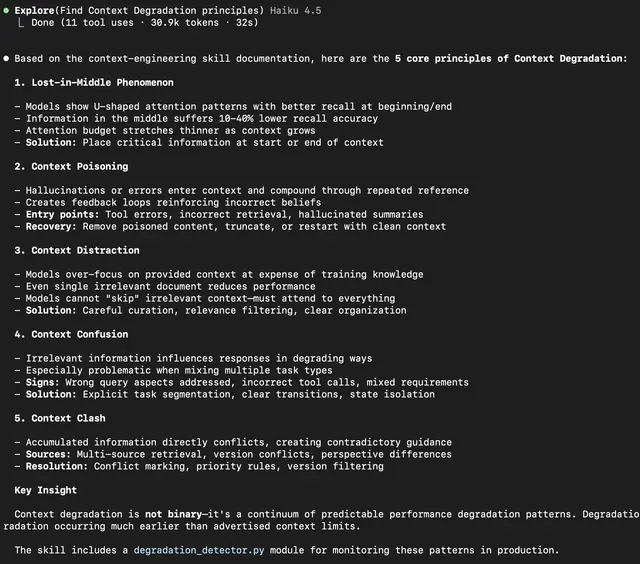
Recognizing Context Degradation Language models exhibit predictable degradation patterns as context grows: the "lost-in-middle" phenomenon where information in the center of context receives less attention; U-shaped attention curves that prioritize beginning and end; context poisoning when errors compound; and context distraction when irrelevant information overwhelms relevant content.
Architectural Patterns
Multi-Agent Coordination Production multi-agent systems converge on three dominant patterns: supervisor/orchestrator architectures with centralized control, peer-to-peer swarm architectures for flexible handoffs, and hierarchical structures for complex task decomposition. The critical insight is that sub-agents exist primarily to isolate context rather than to simulate organizational roles.





