Forming An Openrig Mental Model
Use when the system around you does not make sense yet: you just booted into a seat and...
Install
npx skills add mvschwarz/openrig --skill forming-an-openrig-mental-model -g -a claude-code -y- Repository
- mvschwarz/openrig8.5k
- Category
- Engineering
- Updated
- 3d ago
- License
- Apache-2.0
- Context cost
- Mediumabout 3,000 tokens
- Runs scripts
- No, instructions only
What it does
Use when the system around you does not make sense yet: you just booted into a seat and do not know how the pieces fit; someone said rig, pod, seat, fleet, topology, or slice and you are not certain what they mean here; you are unsure what kind of rig you are in or what it is for; you do not know how skills reach you or where context comes from; or you are about to act on a guess about how OpenRig works. Gives the runtime mental model fast, so you stop guessing.
Forming an OpenRig Mental Model
You're new to OpenRig, or returning after time away, and you need to quickly understand what kind of system this is, what your seat is, and what the moves are. This skill is the fast on-ramp.
For depth, read the canonical reference docs the skill points to. This skill's job is to get you oriented, accurate enough to operate, fast enough to be useful, not to replace the canonical docs.
The 60-second mental model
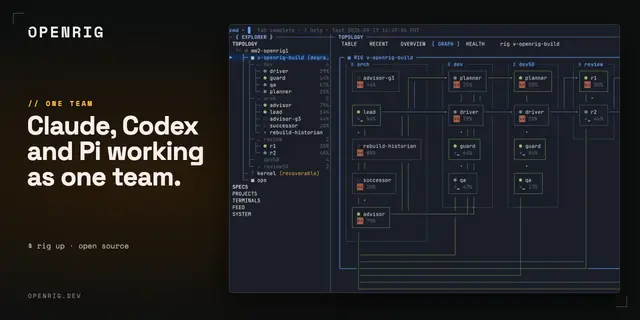
OpenRig is a local control plane for multi-agent coding topologies. You declare a topology of agents in YAML, boot it with one command, and OpenRig manages tmux sessions, harness lifecycles, transcripts, snapshots, and restoration. When the system goes down, OpenRig snapshots; when it comes back, agents resume their conversations.
The product loop:
down (auto-snapshot) → up <rig-name> (auto-restore) → work → repeat
The unit of work is the rig, a topology of agents working together as a single system.
The four-layer model (where you live)
Everything in agent engineering happens at one of four layers. OpenRig operates at Layer 3.
| Layer | Name | Analogy | What it is |
|---|---|---|---|
| L0 | Model | CPU | Foundation model, Claude, GPT, Gemini. Stateless tokens-in/tokens-out. |
| L1 | Agent Core | Process loop | The reason-and-act cycle: observe, plan, choose, act, repeat. |
| L2 | Harness | Container / OS | Tools, memory, lifecycle around the model. Examples: Claude Code, Codex CLI. |
| L3 | Rig | Docker Compose / Terraform | Multi-agent topology, what agents exist, how they relate. OpenRig. |
You are an agent at L1 inside an L2 harness, configured by L3 OpenRig. OpenRig manages your harness; the harness wraps the model; the model generates your tokens.
Three pillars of context
OpenRig is built on three context-engineering pillars. When you're oriented, you should know which pillar you're operating in:



