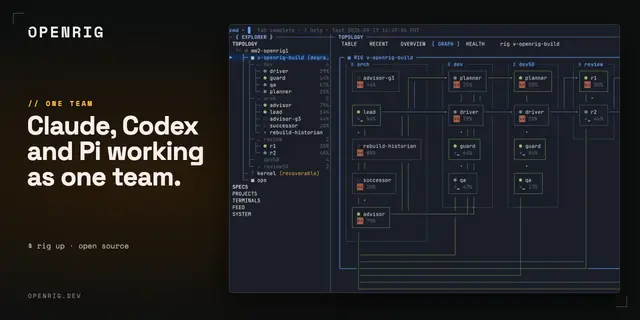
Openrig Operating Model
Use when you do not know WHERE something belongs: you learned a lesson and are unsure...
Install
npx skills add mvschwarz/openrig --skill openrig-operating-model -g -a claude-code -y- Repository
- mvschwarz/openrig8.5k
- Category
- Engineering
- Updated
- 3d ago
- License
- Apache-2.0
- Context cost
- Mediumabout 3,000 tokens
- Runs scripts
- Yes, review before use
What it does
Use when you do not know WHERE something belongs: you learned a lesson and are unsure which file takes it; you are about to create a new doc, folder, or convention; you are asking "should this be a skill, a note, or a chain file?"; you inherited a seat and want to know what SHOULD exist; or you are about to duplicate knowledge that already has a home. Also the trace-to-root: how a seat orients by reading one filename at each level from where it stands up to the fleet.
The OpenRig Operating Model
Canonical term: the Operating Model. How an OpenRig topology organizes every kind of context so that any agent, cold, fresh, or five generations in, can find what it needs and knows where to write what it learns. Authored context stays in addressed Markdown and manifests. Supported writers record semantic judgments; their read models remain rebuildable from those artifacts.
This skill owns the structure: trees, chains, tracing, and placement of authored knowledge. Resolve installed context through its current library addresses and the project's selected loadout; a private corpus is not a required public dependency.
Companion implementation assets in this skill's folder:
templates/andscripts/, starters and working tools, described in §8.
1. The model in one breath
Everything lives on one of two trees, and every kind of context is a chain: the same filename at every level of a tree. To know anything, you trace from where you are toward the root, reading that one filename at each level, nearer levels refine or override farther ones. The trace (§5) is the act of doing that ascent deliberately, with your own file reads.
- Topology tree, how work is done:
fleet → instance → rig → pod → seat. - Work tree, how the product gets built:
project → mission → slice → proof item.
An instance is one OpenRig daemon and the rigs it manages; a fleet is all instances. Where a daemon runs is a deployment fact, not an altitude, say the instance's name when you mean a particular one.



