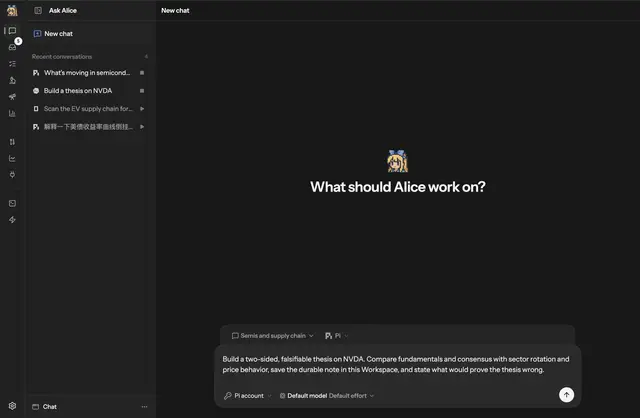
Build Thesis
Build a two-sided, falsifiable thesis on a specific name, the left side (does the...
Install
npx skills add TraderAlice/OpenAlice --skill build-thesis -g -a claude-code -y- Repository
- TraderAlice/OpenAlice7.4k
- Category
- Testing
- Updated
- 12d ago
- License
- AGPL-3.0
- Context cost
- Lightabout 1,368 tokens
- Runs scripts
- No, instructions only
What it does
Build a two-sided, falsifiable thesis on a specific name, the left side (does the number stand up, and where do you differ from consensus) and the right side (is the market itself favoring this, sector, capital, macro, trend). Use when the user has a ticker but no conviction yet: "is the NVDA thesis real", "build a thesis on X", "should I believe the X story", "bull and bear case for Y", "stress-test my view on Z", "is X already priced in", "left side or right side on X", "everyone's buying Y, should I". This is the have-a-name / no-conviction step, it picks up where a value-chain scan hands off ("the next question: is the thesis real?") and turns a name into a thesis you can act on and later monitor.
Build a two-sided thesis on a name
Turn "everyone's talking about NVDA, should I believe it?" into a thesis with a spine: what has to be true, where you differ from the crowd, and what would prove you wrong.
Judge the name from BOTH sides. Most real money is medium- or short-term and can't wait for value to revert, so the right side (is the market actually favoring this?) is usually what drives realized P&L. Don't stop at "it's cheap."
Procedure (don't answer from memory, run the tools)
The tools: traderhub equity for valuation / estimates / consensus,
alice analysis quant for relative strength, momentum, and z-score vs history,
traderhub board for the sector/macro frame. Choose news sources to suit
the question. (See the traderhub, alice-analysis, alice skills.)
-
Anchor the comparison set. The right side is relative, "strong" only means something against peers. If a value-chain map for this name's theme exists in the dossier (from
scan-value-chain), use it as the peer/chain set. If not, sketch the chain first: without it you don't know what to compare against. -
State the claim in one sentence, what has to happen for this to work.
-
LEFT side, does the number stand up, and where do you differ from consensus?
- Your own quant: valuation against its own history and against chain peers; the 2, 3 assumptions the value actually rests on.
- Others' quant: where consensus / estimates sit, and the part that matters, your variant view: where you disagree with the street, and why. No variant view, no edge.
- What must be true (left): the load-bearing valuation assumptions.
- Disconfirming signals (left): what would break the fundamental case.





