Vc Scenario
Generate comprehensive edge cases and test scenarios by decomposing features across 12...
Install
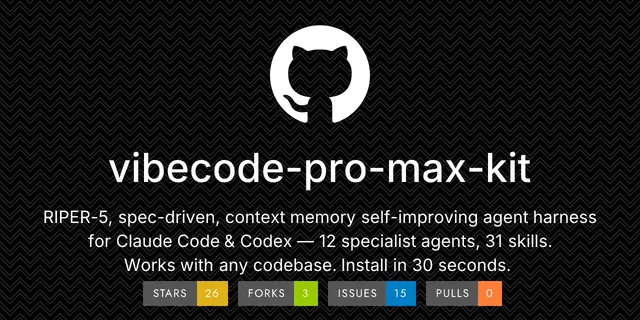
npx skills add withkynam/vibecode-pro-max-kit --skill vc-scenario -g -a claude-code -y- Repository
- withkynam/vibecode-pro-max-kit1.2k
- Category
- Testing
- Updated
- 5mo ago
- License
- MIT
- Context cost
- Mediumabout 1,763 tokens
- Runs scripts
- No, instructions only
What it does
Generate comprehensive edge cases and test scenarios by decomposing features across 12 dimensions. Use before implementation or testing to catch issues early.
vc-scenario, Edge Case & Scenario Explorer
Output style: Follow
process/development-protocols/communication-standards.md, answer-first, plain language, no unexplained jargon, TL;DR on long responses.
Decompose any feature or code path across 12 dimensions to surface edge cases, risks, and test targets before implementation begins.
Mode Selection
Choose a mode before generating scenarios. Default is Simple unless a trigger condition applies.
Simple Mode (default)
Generates edge cases from the plan description, checklist item, or approach text provided in the prompt. No subagent spawned.
Use when:
- The checklist item is self-contained and clearly described
- Blast radius is narrow (1, 2 files, single package)
- No auth, billing, schema, or external API surface is touched
- Speed matters and hypothetical coverage is sufficient
Deep Mode
Spawns a research subagent to read the actual source before generating scenarios. Scenarios reference real variable names, real function signatures, and real failure modes visible in the code rather than hypothetical ones.
Trigger conditions (any one):
- Checklist item modifies an auth, billing, schema, or external API surface
- Blast radius spans 3+ files or 2+ packages
- The plan marks the item as
HIGH_RISK - Caller explicitly requests deep mode
Deep mode subagent steps:
- Reads the actual source files being modified (from plan Touchpoints)
- Locates and reads existing test files for those files (via grep for import paths or describe blocks)
- Reads any Public Contracts affected (from plan's Public Contracts section)
- Returns: real function signatures, actual data shapes, existing test coverage gaps, real failure modes visible in the code
The orchestrator then generates scenarios using the research output.