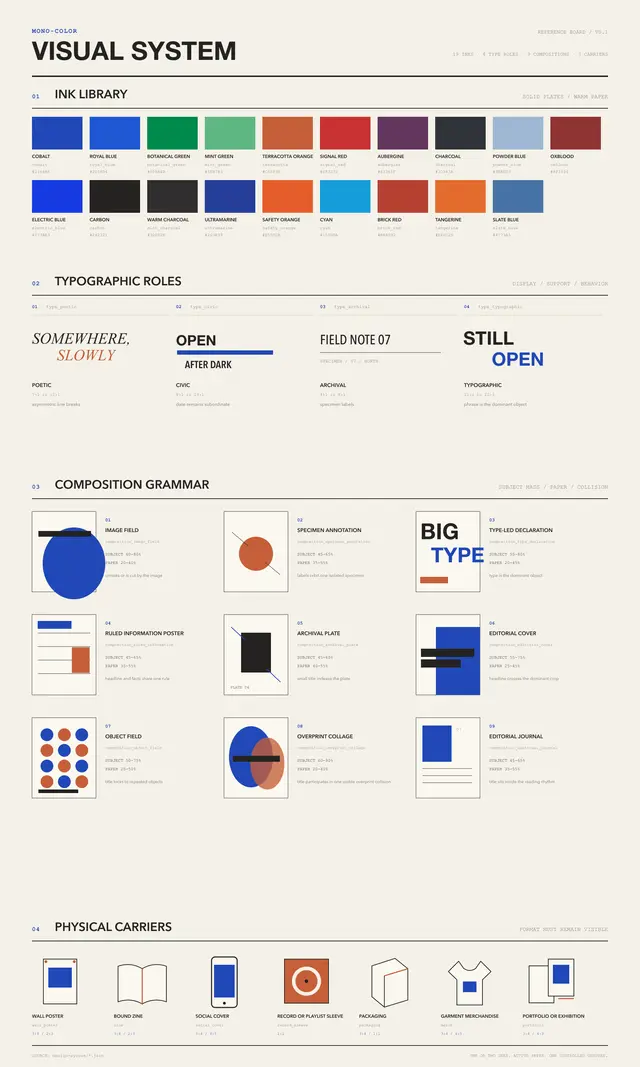
Mono Color
Generate original one-ink or controlled two-ink editorial images from any theme...
Install
npx skills add yanliudesign/mono-color-skill --skill mono-color -g -a claude-code -y- Repository
- yanliudesign/mono-color-skill3.6k
- Category
- Design
- Updated
- 2mo ago
- License
- MIT
- Context cost
- Mediumabout 3,000 tokens
- Runs scripts
- No, instructions only
What it does
Generate original one-ink or controlled two-ink editorial images from any theme, sentence, article idea, object, or reference photo. Always use this skill when the user asks for 单色海报、双色印刷、单色调视觉、蓝色/绿色孔版印刷、risograph、网点照片、复古或当代编辑排版、zine poster, monochrome editorial poster, duotone print, or asks to use the mono-color style. It uses an adaptive white, gray, or pale-beige substrate, no more than two printing inks, active negative space, terse human language, and strong serif/grotesk/mono typography without making retro styling the default or copying a source composition, wording, logo, or artwork. Produce both the final generation prompt and the generated raster image unless the user explicitly asks for prompt only.
Monocolor Editorial Print
Turn any user theme or image into an original printed editorial artifact with one stable visual language:
adaptive neutral substrate + one or two inks + reproduced image + typographic tension + concise human voice
Do not imitate any one reference. Recombine the system below into a new composition every time.
Default Deliverable
Create:
- one final image-generation prompt;
- one generated raster image;
- a short recipe note naming palette, layout family, type pairing, and print process.
Save generated files under ~/Desktop/Claude skills/mono-color/ when a file path is available. Create the folder if needed. Stop at prompt-only only when the user explicitly asks for it or no image-generation capability is available.
Input Reading
Extract four things before composing:
- Subject: the one person, object, scene, or idea that must remain recognizable.
- Intent: poetic observation, announcement, field note, personal statement, cultural poster, or specimen page.
- Words: preserve exact supplied text in its original language. When no text is supplied, invent one English display phrase of 2-8 words and preserve it across retries. Omit display text only when the user explicitly requests a text-free image.
- Image role: hero photograph, isolated specimen, cropped fragment, texture source, or no supplied image.
- Representation: faithful reproduction or abstract symbol extraction. Choose abstract symbol extraction when the user asks for abstract, artistic, loose, experimental, less realistic, or less photographic treatment.
For a complex topic, choose one concrete visual metaphor. Do not illustrate every point.





