Design Dna
Extract, define, and apply design DNA across three dimensions: design system (tokens)...
Install
npx skills add zanwei/design-dna --skill design-dna -g -a claude-code -y- Repository
- zanwei/design-dna2.1k
- Category
- Design
- Updated
- 2mo ago
- License
- MIT
- Context cost
- Mediumabout 1,870 tokens
- Runs scripts
- No, instructions only
What it does
Extract, define, and apply design DNA across three dimensions: design system (tokens), design style (qualitative feel), and visual effects (Canvas, WebGL, 3D, particles, shaders, scroll effects, etc.). Use this skill when: (1) a user wants to see the full 3-dimension design structure/schema, (2) a user provides images, screenshots, or URLs of reference designs and wants them analyzed into a structured JSON profile covering all three dimensions, (3) a user has a Design DNA JSON and content and wants a design generated from it, or (4) any combination of these phases. Triggers on "design DNA", "extract design style", "analyze design", "design tokens from reference", "generate design from JSON", "design system from screenshot", "design profile", "style guide JSON", "visual effects analysis", "design with effects", "3d design analysis".
Design DNA
A 3-phase workflow for extracting, structuring, and applying design identity across three dimensions:
- Design System, measurable tokens (color, typography, spacing, layout, shape, elevation, motion, components)
- Design Style, qualitative perception (mood, visual language, composition, imagery, interaction feel, brand voice)
- Visual Effects, special rendering (Canvas, WebGL, 3D, particles, shaders, scroll effects, cursor effects, SVG animations, glassmorphism, etc.)
Phases
Phase 1: Structure, Output the Schema
When the user asks for the structural dimensions or schema:
- Read references/schema.md
- Present the full schema with field descriptions
- Explain the three dimensions and their roles:
- design_system: What you can measure, exact hex values, pixel sizes, rem scales
- design_style: What you can feel, mood, personality, composition strategy
- visual_effects: What you can see but can't express in CSS alone, WebGL scenes, particle systems, shader distortions, scroll-driven animations
- Ask if the user wants to customize or extend any dimensions
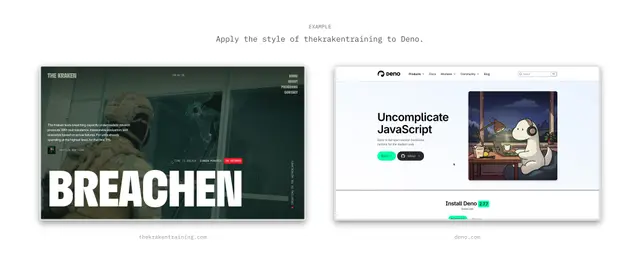
Phase 2: Analyze, Extract DNA from References
When the user provides images, screenshots, or links representing a target design style:
- Read references/schema.md for the full field list
- For each reference provided:
- If image/screenshot: first run the deterministic color measurement (see below), then analyze the remaining visual properties directly
- If URL: fetch and analyze the page's visual design
- For every field in the schema, extract or infer a value from the references
- When multiple references conflict, note the dominant pattern and mention variants
- Output a complete Design DNA JSON, every field populated, no empty strings
- After output, ask: "Want to adjust any values before using this for generation?"
Analysis approach per dimension:





