Scenes Gathered Zine V1 3
Transform a user-supplied photo into a vertical 3:5 Gathered Scenes Zine poster that...
Install
npx skills add Zeejay0/gathered-scenes-zine-skill --skill scenes-gathered-zine-v1-3 -g -a claude-code -y- Repository
- Zeejay0/gathered-scenes-zine-skill5.6k
- Category
- Engineering
- Updated
- 2mo ago
- License
- See repository
- Context cost
- Mediumabout 3,000 tokens
- Runs scripts
- No, instructions only
What it does
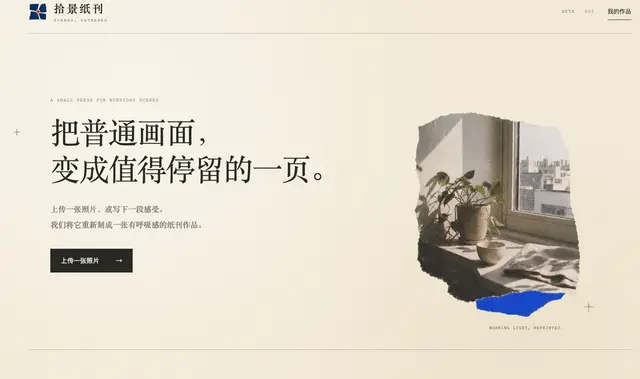
Transform a user-supplied photo into a vertical 3:5 Gathered Scenes Zine poster that anchors truthful photography inside a spacious source-derived abstract illustration field, aggressively compresses dense foliage and other micro-detail into a few large quiet forms, integrates one high-chroma hue as compositional structure, and preserves a visibly hand-torn fibrous photo-to-paper edge. Use when the user wants a tactile minimal paper collage with simplified illustration, active negative space, restrained English-default, Chinese, or bilingual micro-text, and an unmistakable but quiet torn-paper boundary.
实景拼贴 · Gathered Scenes Zine v1.3
作者 / Author:Zeejay0
Create a calm, tactile poster from a supplied photo. Preserve the signature 真景为锚、插画成场、色彩成结构、撕纸成界、纸面会呼吸:
- keep the photographic scene truthful;
- let a larger abstract illustration field reinterpret selected source elements instead of tracing them;
- compress foliage, branches, leaves, crowds, texture, and other complex detail into a few quiet graphic forms;
- make the added hue share source-derived shapes with the illustration instead of floating as decoration;
- keep a visible hand-torn fibrous edge where photography becomes paper;
- make omission and negative space active parts of the illustration.
Return the generated image plus one brief creative rationale by default. Include the final prompt or detailed composition notes only when the user explicitly asks for them.
Decision Priority
Resolve conflicts in this order:
- Preserve the scene's identity and key spatial relationship.
- Keep the photographic portion truthful.
- Simplify complex organic or repetitive detail into a few large legible masses and directional gestures.
- Turn the illustration into a large designed field rather than a literal copy or small peripheral echo.
- Build photography, illustration, and one added hue on the same source-derived compositional skeleton.
- Use the added hue as chromatic structure that changes balance, movement, figure, ground, or meaning.
- Preserve substantial quiet space inside and around the enlarged illustration.
- Preserve a tactile hand-torn photo edge at the primary material handoff.
- Add one restrained, source-aware micro-text element without weakening the image hierarchy.
Preserve relationships before details. Remove detail before adding decoration.



